

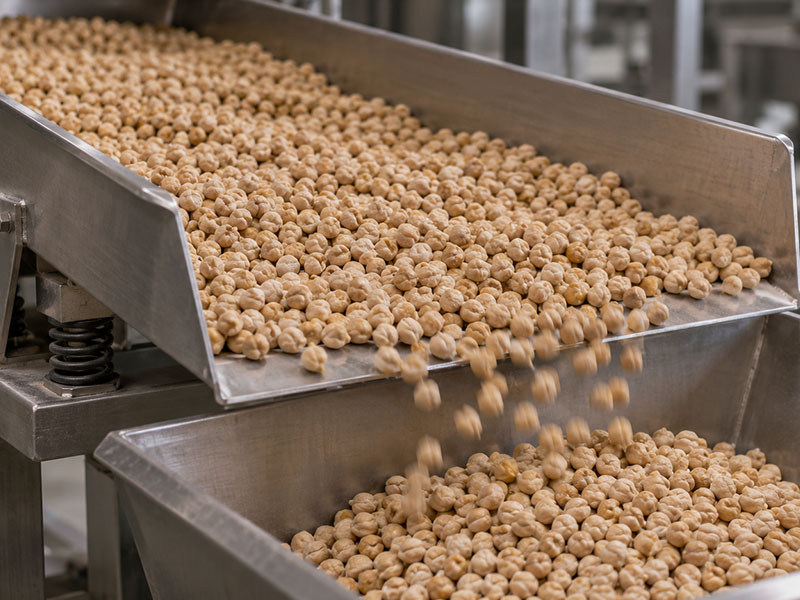
04 Nov How dry pulses are processed: cleaning, sizing, optical sorting and packaging
A lentil, a chickpea or a bean arrives from the field with stones, soil, plant debris, broken grains and other seeds. What consumers find in the bag is the result of several processing stages that determine the final quality of the product.
For a retail buyer, an importer or a food manufacturer, understanding this process is more than a technical detail. It explains why two batches of the same variety can perform very differently on the shelf, in the kitchen or on a production line.
In this article we explain, step by step, how raw grain becomes a product ready for sale: receiving, cleaning and destoning, sizing, optical sorting and packaging.
1. Receiving and raw material control
Quality starts before the grain enters the line. Every consignment that arrives at the plant is identified by batch, origin and supplier, and a representative sample is taken for analysis.
At this stage, the parameters checked include:
-Moisture: determines the stability of the grain during storage.
-Size and uniformity: whether the consignment matches the agreed specification.
-Impurities and foreign matter: stones, soil, plant debris or other seeds.
-Grain defects: broken, stained, wrinkled, insect-damaged or off-colour grains.
-Pests: visual inspection for live insects or recent damage.
-Documentation: certificates of analysis and, for organic products, the operator certificate and transaction documents.
Consignments that do not comply are rejected or put on hold before they can be mixed with other batches. Accepted ones are stored separately by variety, origin and production type.
2. Cleaning and destoning
Cleaning removes everything that is not a pulse. It is the stage with the greatest impact on product safety, because a stone that reaches the consumer is a physical hazard and a guaranteed complaint.
Several machines are combined, each based on a different physical property:
-Pre-cleaning and aspiration: air currents remove dust, husks, straw and light particles.
-Screens: separate by size the impurities that are larger (clods, sticks) and smaller (sand, small seeds) than the grain.
-Gravity table: separates by density the empty, insect-damaged or underdeveloped grains, which weigh less than a sound grain.
-Destoner: removes stones and clods of the same size as the pulse, which screens cannot tell apart.
-Magnetic separation: magnets on the line capture any metal particles.
Destoning is especially critical for lentils and chickpeas, because small stones are very similar in size and shape to the grain.
 3. Sizing
 3. Sizing
Sizing (or grading) sorts the clean grain by size. It is done with calibrated screens, with round or slotted holes depending on the shape of the pulse, which split the product into uniform fractions.
A uniform size has three direct benefits for the customer:
-Even cooking: grains of the same size cook at the same time, without mushy grains mixed with hard ones.
-Shelf appeal: a bag of uniform grain conveys quality to the consumer.
-Compliance with the specification: size is part of the technical data sheet of many products, especially chickpeas and beans, and is one of the differences between commercial grades.
Fractions outside the specified size are separated from the main product. Depending on their quality, they can be used for other purposes.
4. Optical sorting
Optical sorting is the last quality filter before packaging. It detects and removes, grain by grain, the defects that mechanical stages cannot separate because they have the same size and weight as a sound grain.
The pulses fall in a continuous curtain in front of high-resolution cameras. The system compares each grain with the programmed criteria and, when it finds a defective one, ejects it with a blast of compressed air within milliseconds.
Optical sorting removes:
-Stained, discoloured or off-variety grains.
-Insect-damaged grains or grains with damaged skins.
-Seeds of other species and grains of other pulses.
-Stones, glass or other foreign matter that got past the cleaning stage.
The advantage for the buyer is consistency. Sorting criteria are set to each customer’s specification and applied equally to the whole batch, something manual sorting cannot guarantee at industrial scale.
5. Packaging
 5. Packaging
The cleaned, sized and sorted grain then moves to the packaging lines. There it is dosed by weight, packed, sealed and each unit is marked with its batch number and best-before date.
Before the case is closed, every unit goes through in-line checks:
-Checkweighing: confirms that each pack meets the declared net content.
-Metal detection: the final barrier against metal foreign bodies.
-Label and coding verification: batch, date and data are legible and correct.
At Autor Foods, we pack dry pulses in three formats. All of them are available in conventional and organic pulses, and can be customised with the customer’s brand:
| Format | Typical use |
|---|---|
| 500 g | Retail shelf and private label |
| 1 kg | Retail shelf, family size |
| 5 kg | HORECA, catering and small-scale industry |
Traceability and food safety throughout the process
Every bag must be traceable back to its original consignment. To make this possible, the batch number follows the product through every stage and is linked to receiving, processing and dispatch records. This traceability makes it possible to act quickly in the event of any incident, and it is one of the requirements audited under IFS Food certification.
Organic pulses follow the same stages, but with additional requirements set out in Regulation (EU) 2018/848:
-Physical or time separation: organic products are stored and processed with no risk of mixing with conventional ones, and lines are cleaned between runs.
-Pest control without unauthorised synthetic products in the facilities and storage areas.
-Specific documentation: supplier certificate and records proving the organic integrity of each batch.
-Audits by the authorised control body.
What buyers should ask their dry pulses supplier
If you are evaluating a manufacturer for your private label or a supplier for your production, these questions will help you compare:
1.What checks are carried out when raw material is received, and what happens to consignments that do not comply?
2.Does the line include a destoner, gravity table and optical sorting, or only screen cleaning?
3.Can size and sorting criteria be adjusted to my specification?
4.What final checks does packaging include: weight, metal detection, code verification?
5.What certifications does the plant hold (IFS, BRC, organic)?
6.How quickly can a batch be traced from the pack back to its origin?
7.Do you also offer cooked pulses, so I can source dry and cooked pulses from a single supplier?
 The quality of dry pulses does not depend only on their variety or origin. To a large extent, it depends on how they are cleaned, sized, sorted and packed. That is why choosing the right pulse supplier matters. At Autor Foods we process dry pulses and produce cooked pulses, both conventional and organic, for private label, food service and industry. If you are looking for a supplier for your next project, contact us and we will send you our technical data sheets.