

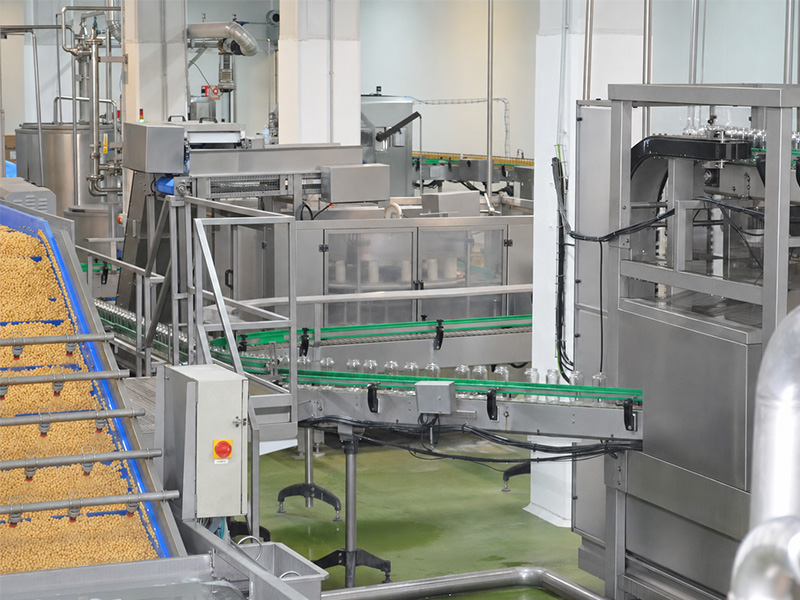
23 Jul How pre-cooked pulses are made: a complete guide to the industrial process
A tin of pre-cooked chickpeas can last up to five years on a shelf, at room temperature, without a single preservative. It isn’t magic, nor is it aggressive chemistry: it’s physics applied with a great deal of precision. Between the sack of dry pulses that enters the factory and the container that reaches the shelf, there are a dozen linked operations, each with its own controls, timings and margins for error.
At Autor Foods, we have been producing pre-cooked pulses for more than a century. This guide walks through the complete process, explains why each step sits where it does, and sets out how beans, lentils and chickpeas differ within one and the same production line.
What a pre-cooked pulse in a tin actually is (and why it keeps without refrigeration)
A tinned pulse is a commercially sterile product. The distinction matters: it doesn’t mean that absolutely nothing inside is alive, but rather that a heat treatment has been applied that is sufficient to destroy every microorganism capable of multiplying under the normal storage and distribution conditions of the product.
The key lies in pH. Pulses are low-acid foods: their pH sits around 5.8-6.5, well above the 4.6 threshold that marks the regulatory and microbiological boundary. Below that value, acidity alone prevents the growth of Clostridium botulinum; above it, there is no natural barrier to hold it back. And that bacterium forms spores that survive boiling water for hours.
This is why a tinned pulse cannot be pasteurised: it has to be sterilised. The industry’s reference treatment, known as the botulinum cook, is equivalent to holding the coldest point of the container at 121 °C for at least three minutes. In industrial practice, far wider safety margins are used, because beyond the health risk there are also more heat-resistant spoilage microorganisms that pose no danger but ruin the product.
Everything that follows exists to make that heat treatment possible, uniform and verifiable.
Raw material reception and acceptance criteria
The process begins long before the factory. Dry pulses are an agricultural product with enormous variability between harvests, origins and varieties, and that variability conditions everything that happens afterwards. We explain this in detail in our comprehensive guide to pulses as a raw material in the food industry and in our article on provisioning in the food industry.
 Every lorry that unloads passes through an incoming control that decides whether the batch is accepted, accepted with conditions, or rejected. The usual parameters:
-Grain moisture. Around 12-14 %. Above that, there is a risk of fungal development during storage. Below it, there is a high probability that the grain will be brittle and break during handling.
-Impurities and foreign bodies. Stones, soil, plant residues, grains of other species.
-Broken, shrivelled or damaged grain. This affects yield and final appearance.
-Size grading and uniformity. Decisive in achieving an even cook.
-Absence of pests and of insect damage.
-Analysis: mycotoxins, plant protection product residues, heavy metals.
-Cookability test. This is the most sector-specific check of all: a pulse stored for a long time in hot, humid conditions develops the hard-to-cook phenomenon. In other words, it hardens and no longer hydrates properly however long the soak is extended. A batch like that is unusable for tinning even if it meets every other requirement.
Each accepted batch receives an identifier that will accompany it all the way to the final container. That traceability is what makes it possible, should it ever be necessary, to narrow an incident down to a specific batch rather than an entire harvest.
Cleaning, grading and sorting
The pulses pass through a cleaning train that works by exploiting the physical differences between the grain and everything that isn’t grain:
-Screening. Vibrating screens with different mesh sizes separate out anything too large or too small.
-Aspiration. An air stream carries away dust, husk and light material.
-De-stoning and gravity separation. These separate by density the stones and clods of earth that are the same size as the grain and that the screens do not detect.
-Magnetic separation. This removes ferrous particles originating from transport or from agricultural machinery.
-Optical sorting. Cameras analyse each grain in free fall by colour, shape and defect, and eject it with a puff of compressed air if it doesn’t comply. This is what removes stained, broken or off-variety grains.
-Final grading. This classifies the cleaned grain by size.
That last point is not cosmetic. A large grain and a small one hydrate and cook at different rates: if they go into the same tin together, either the small one ends up disintegrated or the large one stays hard. Grading is what makes it possible for the entire contents of a container to have the same texture.
Hydration: the step where the pulses differ most
Soaking returns to the grain the water it lost as it dried in the field. A dry grain that enters the autoclave without hydrating doesn’t cook: it hardens. That is why pulses must go through the hydration stage.
 During hydration, the grain can double its weight. Water penetrates through the hilum and the seed coat, the starches begin to prepare to gelatinise, and the proteins hydrate. This is also the moment when some of the oligosaccharides — raffinose and stachyose — responsible for the flatulent reputation of pulses are drawn out, one of the points we address in 5 major lies about pulses.
The parameters controlled are the grain-to-water ratio, the water temperature and the time. Temperature is the delicate variable: raising it shortens the soak, but beyond a certain point the bath begins to ferment and problems appear with odour, acidity and initial microbial load. This is why long soaks are carried out cold or under controlled conditions, with water renewal.
And this is where the three pulses stop behaving alike:
| Beans | Lentils | Chickpeas | |
|---|---|---|---|
| Soaking | Long | Very short or none | Long |
| Seed coat | Thin and fragile | Thin, tightly attached | Thick and resistant |
| Typical risk | Detached skin and split grain | Disintegrated or broken grain | Hard centre, uneven hydration |
| Water absorption | High | Fast | High and slow |
It isn’t straightforward, though, because beans have a thin skin that comes away easily if hydration is abrupt. Chickpeas have exactly the opposite problem: a thick coat that is hard to penetrate. And lentils hydrate so quickly that a prolonged soak ruins them. Each pulse has its own particularities. That is why each has its own article with the full detail of its process:
–How are pre-cooked beans produced?
-How are pre-cooked lentils produced?
-How are pre-cooked chickpeas produced?
Blanching
After hydration, the pulses pass through a hot water bath for a few minutes. It is a brief operation that fulfils four functions at once:
-It de-aerates the tissue. Hydrated grain contains occluded air. If that air enters the sealed container, it expands in the autoclave, raises the internal pressure and can deform the container or compromise the seal. In addition, residual oxygen encourages internal corrosion of the tin and darkening of the product.
-It inactivates enzymes responsible for browning and for losses of colour and aroma during shelf life.
-It reduces the initial microbial load, which gives additional margin to the subsequent heat treatment.
-It sets and stabilises the colour of the grain.
It is a step that goes unnoticed and that nonetheless explains much of the difference in appearance between a well-made tinned product and a mediocre one two years into its life.
Filling and covering liquid
The filling process consists of dosing into each container the exact quantity of grain corresponding to the drained weight declared on the label. This is a legal parameter: drained weight is what the consumer is actually buying, and it is monitored continuously on the line.
 The covering liquid is then added over the grain, and it is not filler. It performs an essential thermal function: the liquid transmits heat by convection inside the container far better than the grain would on its own, and it is what allows the centre of the tin to reach sterilisation temperature within a reasonable time. Without liquid, the interior of the mass of pulses would take so long to heat that the product at the periphery would be destroyed before the centre was safe.
The standard covering liquid is water and salt. Depending on the formulation and the destination of the product, the following may be incorporated:
-Antioxidants and metal sequestrants, which prevent darkening and staining caused by reaction with metal traces.
-Calcium salts, which reinforce the structure of the grain and improve firmness.
-Acidity regulators, to adjust pH within specification.
In recent years, demand for clean label formulations — pulses, water and salt only — has grown strongly, particularly in private label. It is technically feasible, but it requires better raw material and tighter process control, because the aids that compensate for variability disappear. All of this information ends up captured in the document that summarises the product: the technical data sheet.
The liquid is dosed hot, and a headspace is left in the container. That gap is what, as the product cools and the steam contracts, generates the vacuum that keeps the lid firm and the product protected.
Sealing the container
Sealing is one of the two critical points of the process. A perfect heat treatment on a badly sealed container is worth nothing: the product is recontaminated and spoils.
In tins, sealing is achieved by a mechanical double seam: the machine rolls and compresses the edge of the body and that of the lid until five thicknesses of metal are interlocked with a sealing compound. There is no welding and no adhesive, only geometry. The height and thickness of the seam, the length of the body and cover hooks, the overlap percentage, the tightness rating and the presence of wrinkles are all controlled.
In glass, the seal is provided by the compound gasket in the metal lid, which is compressed against the rim of the jar. Control here centres on the application torque and on the level of vacuum achieved.
In both cases, samples are taken at fixed intervals and a complete seam teardown is carried out in the laboratory. Any deviation requires production to be blocked back to the last conforming check.
Sterilisation in the autoclave
This is where the essential part happens. The sealed containers are loaded into baskets and enter the autoclave, where they undergo a cycle with three phases:
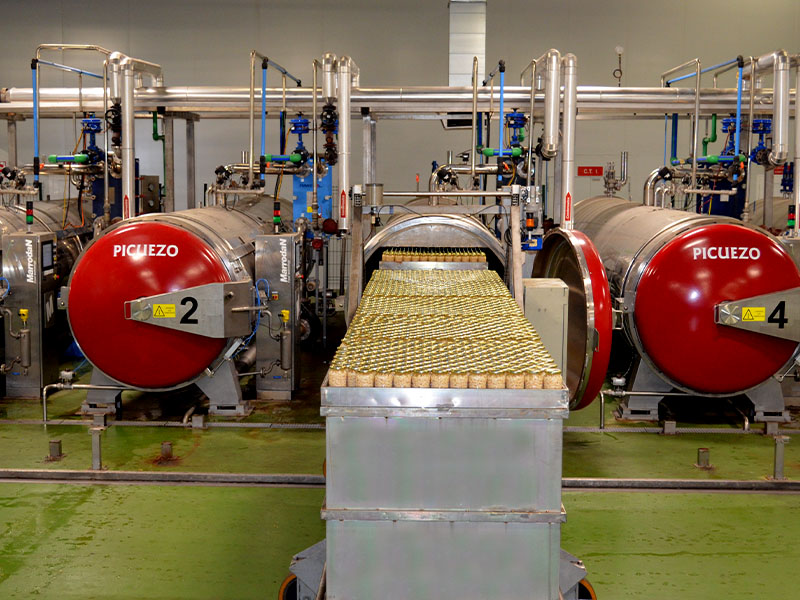
-Come-up time. The autoclave reaches the set temperature. In steam cycles it is essential to purge all the air from the chamber: residual air creates cold pockets that mean some containers receive less heat than others.
-Holding. The time at temperature during which lethality accumulates. It is calculated from heat penetration studies: containers are instrumented with probes at the coldest point — which in a convection product is not exactly the geometric centre — and the evolution of temperature is measured.
-Cooling. The temperature is brought down quickly to halt overcooking. This is the phase of greatest microbiological risk in the entire process, because as it cools the contents contract and generate a momentary vacuum that can draw water in through microfissures in the seal. This is why the cooling water is chlorinated and its disinfectant level monitored continuously.
Glass imposes an additional condition: overpressure has to be applied. Without it, the internal pressure of the hot jar exceeds that of the chamber during cooling, the lid lifts and the container loses its seal or bursts. For this reason, and to avoid thermal shock, glass cycles are slower and gentler in their temperature ramps.
The temperature distribution of the autoclave is validated periodically with probes distributed throughout the chamber, and every cycle is recorded. That record is a food safety document: it demonstrates, batch by batch, that the treatment was applied. We go deeper into the equipment and its role in how autoclaves are transforming the food industry.
Cooling, drying, coding and labelling
Containers leave the autoclave at an intermediate temperature, around 35-40 °C. They are deliberately not cooled completely: the residual heat evaporates the surface water and leaves the container dry. A wet container that is handled is a direct route to recontamination and, in the case of the tin, a focus for external corrosion.
Once dry, the containers pass through coding. Each one receives the batch number and the best-before date, marked by laser or inkjet. That code is the link joining the individual container to the raw material batch, the autoclave cycle and every production record. It is the basis of traceability and of any selective recall. We cover the subject thoroughly in food product coding.
Labelling, bundling and palletising follow, each with its own logistics coding.
Quality control and the HACCP view of the process
Everything described above is governed by a self-monitoring system based on hazard analysis and critical control points. On a pre-cooked pulse line, the critical control points are usually four:
-The integrity of the container seal.
-The heat treatment in the autoclave.
-The chlorination of the cooling water.
-Metal detection.
Around these sits a network of quality controls that are not critical to safety but are critical to the product: drained weight, pH, salt content, vacuum level, grain firmness measured with a penetrometer, colour, percentage of broken or skinless grain, and sensory tasting.
The full logic of the system, with its critical limits, monitoring, corrections and verification, is explained in HACCP, the invisible guardian that controls all hazards in the food industry. And in how to make and store pre-cooked pulses to guarantee food safety we set out the good practices that continue beyond the factory, in the warehouse and at the point of sale.
This framework is also what the certification schemes recognised by large retailers audit. We have written about one of the most demanding in how to obtain the highest score in IFS Food certification.
Quarantine, incubation and batch release
Finished product doesn’t leave the factory the next day. There is one final barrier first.
Part of every batch undergoes incubation: the containers are held for several days in incubators at two different temperatures, one around 30-37 °C and the other around 55 °C. The first detects surviving mesophilic microorganisms; the second, thermophilic spore-formers that would not grow under normal storage conditions but do reveal a failure in the treatment. If something was not destroyed, it shows itself here: swollen containers, loss of vacuum, changes in pH or in odour.
In parallel, the external appearance of the production run is inspected, outstanding analyses are completed, and all batch documentation is verified as conforming: autoclave records, seam controls, laboratory results and traceability.
Only then is the batch released. And a retention sample of each one is kept, preserved until the end of its shelf life, which makes it possible to go back to the product if any query or incident arises long afterwards.
This sequence is the reason a tinned pulse achieves a shelf life of up to five years while maintaining its safety and much of its organoleptic character.
Tin and glass: what changes in the process depending on the container
At Autor Foods we work with two formats, tin and glass, and they are not interchangeable from an industrial point of view.
 The tin is a thermally efficient container: metal conducts heat quickly, which allows shorter autoclave cycles and, therefore, treatments that are gentler on the product despite achieving the same lethality. It is light and opaque — protecting the product from light, which degrades colour and nutrients — impact-resistant, and highly efficient in transport and palletising. Its interior carries a lacquer that isolates the food from the metal and prevents reactions and migration. It is the natural format for high volume and for the price-driven channel.
Glass is thermally slower and mechanically more delicate. It requires overpressure in the autoclave, gentler heating and cooling ramps to avoid thermal shock, and more careful handling throughout the line. In exchange, it is inert — it contributes absolutely nothing to the product — reusable by the consumer, and above all it lets the contents be seen, which in pre-cooked pulses is a direct selling point: whole, uniform, good-coloured grain sells itself. It is the format of premium positioning and of the product that wants to be seen.
The choice is not purely about image. It conditions unit cost, line speed, logistics cost, the shelf the product aspires to, and even the consumer profile. In a private label development, it is one of the first decisions that has to be settled, because it drags all the others behind it.
From process to product
Understanding the process serves one very concrete purpose: knowing what to ask a supplier. When a retailer or a brand is assessing who should manufacture its pre-cooked pulses, the questions that separate a sound supplier from an unsound one come from exactly here. How does it approve its raw material batches? How often does it carry out seam teardowns? How long does it incubate before release? What flexibility does it have to adapt a formulation?
If you are considering producing your own range, in how to choose a cooked pulses manufacturer for your private label we develop the full set of criteria, and on our distributor brand page we explain how we handle these projects from the first briefing to the shelf.