

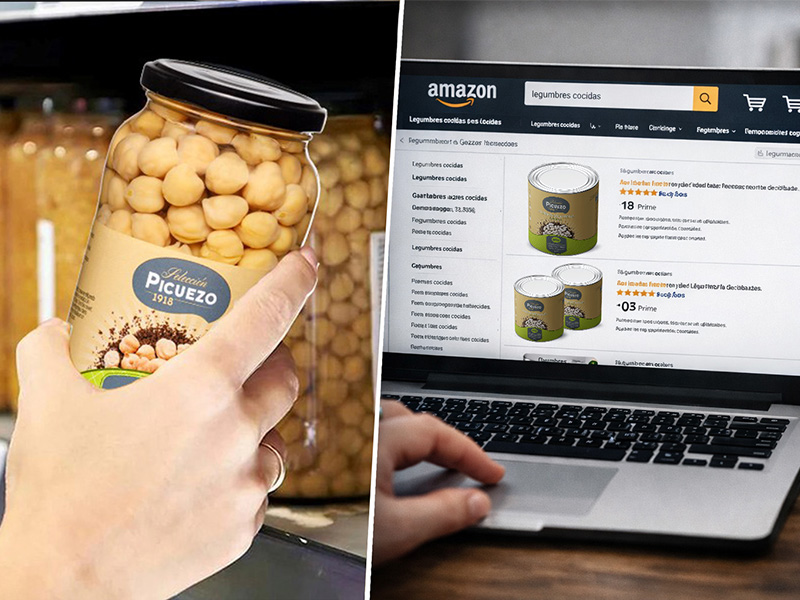
30 Mar What nobody tells you about selling food on Amazon
Our experience on Amazon has taught us that selling food online isn’t just about the product range. It’s about the business model.
Just like at Autor Foods, for years, many companies in the food sector have seen Amazon as an obvious opportunity: a growing channel, with direct access to the consumer and without the traditional barriers of retail.
We saw it that way too. And we decided to get involved.
What we found was very different from what we expected. Because selling food on Amazon isn’t simply a matter of transferring your catalogue to a new channel. It’s competing in an environment with completely different rules.
At Autor Foods, we have been producing cooked pulses for over 100 years. Our business has been built alongside large-scale distribution, developing products for private labels and working with major supermarket chains. We know how that environment works.
But Amazon is something else entirely.
Below, we share the key lessons from an experience that didn’t go as we’d hoped, but which allowed us to better understand the limits — and opportunities — of e-commerce in the food sector.
Being on Amazon is not the same as having a strategy
One of the first mistakes was assuming that ‘being on Amazon’ was, in itself, an online sales strategy. We set up our catalogue, uploaded products and activated logistics. But on Amazon, that isn’t enough.
Amazon isn’t a digital shelf. It’s an environment where visibility depends on multiple factors: internal positioning, advertising spend, conversion, turnover and reputation.
That’s why our recommendation is that, before you start on Amazon, you clearly define what you want this platform to be for your business: a direct sales channel, a brand showcase, a channel for testing new products…
Defining this objective will allow you to operate with focus and achieve results.
The real cost is much higher than it seems
One of the key lessons was understanding the true cost of selling food online. It is true that Amazon reduces friction for the consumer, but it shifts that complexity to the supplier in terms of sales commissions, storage, promotions, advertising spend on Amazon Ads and logistics costs. This is particularly true with FBA (Fulfillment by Amazon), which is Amazon’s logistics management service: a service where you, as a manufacturer or seller, delegate the entire logistics operation to the platform.
This means that you send your product to Amazon’s warehouses, where it is stored. When a customer makes a purchase, Amazon prepares the order, dispatches it and handles customer service and any returns. In other words, Amazon becomes your full-service logistics provider.
In categories such as cooked pulses, where the unit price is low, this cost structure puts direct pressure on the margin.
In an industrial model like ours, optimised for volume and efficiency in large-scale distribution, this cost structure simply does not fit without redesigning the entire proposition.
This forced us to choose between raising prices and losing competitiveness, or maintaining prices and eroding margins. Neither option was viable.
The product doesn’t work the same way in e-commerce
Another key mistake was failing to adapt our offering to the channel.
In physical retail, consumers buy individual products or standard formats. On Amazon, behaviour is different. That is why our recommendation is that you develop differentiated offerings, specific packs for e-commerce and bundles optimised for average spend.
In other words, above all, avoid taking a product designed for physical shelves into a digital environment because the logic is completely different.
On Amazon, content sells
In food e-commerce, the product listing replaces the packaging, the shelf and the sales assistant. So, if you want to sell on Amazon, it is essential that you invest in images optimised for conversion, generate rich content, work on internal SEO on Amazon using your relevant keywords, and prioritise benefit-oriented descriptions.
You should also actively work on your product reviews, as they are one of the key factors in driving conversions. On Amazon, if you don’t set up your product listing properly, you simply don’t exist.
No advertising, no visibility
On Amazon, the role of advertising is clear, so if you want to sell on this platform, you’re going to have to pay. The fact is that Amazon is, in practice, a search engine. And like any search engine, it prioritises results that generate financial returns and, therefore, the companies that invest in advertising.
Although this doesn’t guarantee results, what is clear is that if you don’t allocate a budget to Amazon Ads, you’ll have less visibility and less traffic because advertising isn’t an add-on; it’s a structural part of the model.
Amazon demands a different operating model
Amazon demands a different way of operating based on five elements:
-Direct consumer management.
-Dynamic price control.
-Constant optimisation.
-Rapid response to demand.
-Real-time stock management.
This model requires specific teams, processes and a specific mindset. It is not a question of integrating Amazon into the company’s usual operations, but of understanding that it is an almost independent channel.
That lack of operational adaptation can end up being a hindrance. That was the case for us because, in truth, Amazon never became a strategic priority. In fact, it was competing for resources with the retail channel, where we have:
-Scale
-Established relationships
-Clear competitive advantages
Unrealistic expectations regarding growth
Another key point is the timeframe. Don’t expect to generate volume in the short term because, in food e-commerce, building positioning, reviews, traffic and repeat purchases takes time.
 Although we didn’t achieve the expected results, the experience taught us valuable lessons about food e-commerce:
-Margins in the food sector are particularly sensitive in e-commerce. For products with a low unit price, any additional cost —commissions, logistics or advertising— has a direct and disproportionate impact on the margin, making it very difficult to maintain profitability without adjusting the model.
-Logistics has a direct impact on profitability. In e-commerce, logistics ceases to be an operational cost and becomes a critical factor in the business: it defines the final price, dictates the sales format and can determine whether a product is viable or not.
-Amazon is not a tactical channel; it is a business model. Operating on Amazon involves adapting prices, products, marketing and operations to its rules, so it does not function as an additional channel, but as a system that demands its own strategy and structure.
To say that “it didn’t work” is true. But what really matters is understanding why: not all channels are suitable for all businesses.
Today, we are clear that our value lies not in replicating sales models, but in understanding where we truly provide a competitive advantage.
And in our case, that continues to lie in the development of retail solutions, where we can offer:
-Scale.
-Industrial efficiency.
-In-depth knowledge of the sector.
Because it’s not about being in every channel.
It’s about being in those where you can really compete… and win.