


26 Sep HACCP, the invisible guardian that controls all hazards in the food industry
The HACCP (Hazard Analysis and Critical Control Points) self-monitoring system is a preventive methodology applied in the food industry to ensure food safety. Its main objective is to identify, evaluate and control hazards (biological, chemical and physical) that may arise during the production, handling, storage and distribution of food, thereby avoiding risks to consumer health.
It is a kind of invisible guardian that controls all hazards in the food industry. Perhaps its most important feature is that it is a preventive system, as it seeks to avoid problems before they occur. This is why it is based on hazard analysisand the determination of critical control points (CCPs).In other words, stages of the process where a failure could compromise food safety. This will depend on each company. Therefore, each entity must adapt it to its specific processesbecause it is not a generic plan.
Its recognition and widespread implementation in food companies is due to the fact that the HACCP system is backed by European legislation, making it mandatory for companies in the food sector. It is also mandatory in many other countries that apply similar regulations.
The HACCP system is based on seven principles that constitute a mandatory food safety systemand ensure that the food that reaches the consumer is safe and harmless. These are:
-
- Identify hazards and analyse risks.
- Determine critical control points.
- Establish critical limits for each critical control point.
- Define a monitoring system for critical control points.
- Establish corrective actions if something goes wrong.
- Apply verification procedures to confirm that the system is working.
- Implement a record-keeping and documentation system.
1.Identify hazards and analyse risks
 The objective of the first principle is to detect all potential hazards (biological, physical, chemical and allergens), assess their probability and severity, and prioritise controls. To do this, start by mapping the process in steps (receipt, storage of raw materials, cleaning, production phases, labelling, storage, distribution, etc.). At each of these stages, list the potential hazards by category:
-
- Biological, such as clostridium spores, salmonella, listeria, etc.
- Chemical, such as pesticide residues in raw materials, detergent/disinfectant residues…
- Physical, such as any type of foreign body.
- Allergens due to cross-contamination
Each risk is then analysed and assigned a priority: high, medium or low, depending on its severity/dangerousness and risk.
In this first phase of the HACCP system, the measures applied are also classified as prerequisite programmes or critical controls. The most common are relationships with approved suppliers, pest control, cleaning and disinfection of facilities, maintenance work, staff training, traceability, etc.
2.Determine the critical control points
It is necessary to identify the steps in the process where loss of control could lead to an unacceptable risk and where it is possible to apply a preventative and monitorable measure to control it. To decide which steps these are, it is most common to use a Codex-type decision tree ( ) in which questions such as the following are asked: Is there a preventive measure? Does the step eliminate/reduce the hazard to an acceptable level? Can this parameter be measured and controlled? If the answer is yes, it is likely to be a critical control point.
For example, in the case of legumes, a critical control point would be the hermetic sealing of the container because poor welding or sealing can allow contamination or microbial growth.
3.Establishing critical limits
 This involves defining the maximum/minimum values or characteristics that separate the acceptable from the unacceptable at each critical control point. Some of these types of limits are:
-
- Thermal parameters, such as the time/temperature ratio of the process
-
- Sealing or tightness, such as the minimum validated vacuum in jars
- pH/aw, such as acidity or moisture limits
- Instrumental limits, such as the maximum number of damaged parts per batch
- Microbiological limits, such as the absence of pathogens in X g/unit
For these limits to be truly useful, they must always be established based on validation and not on estimates. It is also advisable to define the measurement tolerances and accuracy of the instruments used.
4.Define a monitoring system
It must be established how critical control points are monitored, how often, who does it, and what instruments are used to detect deviations in time. The key elements of this monitoring system are:
-
- Type: continuous automatic monitoring and batch monitoring
- Instrumentation and calibration: temperature recorders, pressure sensors, leak detectors, visual inspection machines, etc.
- Sampling frequency: defined according to the risk and size of each batch.
- Sampling method and sample size: based on batches and statistical analysis or risk.
- Automatic forms and records: with the measured value, OK/not OK and signature.
5.Establish corrective measures
 Specific, phased actions must be defined for immediate implementation when monitoring detects deviations. Corrective measures begin with immediate action to protect safety: quarantining a batch for evaluation. To do this, records are reviewed, it is determined whether the deviation implies a loss of safety, and it is decided whether to reprocess or destroy the product. In either case, technical actions will be taken to correct the cause and control tests will be performed on all products after the correction has been applied.
At the same time, the entire process is recorded and reported by completing non-compliance forms, notifying the person responsible for quality and, where appropriate, notifying the competent authorities.
6.Apply verification procedures
In order to ensure that the HACCP system is working properly, periodic checks must be carried out to ensure that it is fulfilling its purpose and that the controls are effective. To this end, validations and verifications are carried out. A validation consists of an initial test and subsequent tests that demonstrate that the critical limits and processes are adequate to control hazards.
Verification, on the other hand, encompasses all those regular activities that confirm that the plan is being implemented and that the controls are still working, such as internal audits or calibrations. Some recommended verification activities are performed daily, such as reviewing critical records; others weekly, such as microbiological sampling of finished products; others monthly, such as reviewing open corrective actions; others annually, such as a complete HACCP system audit; and others are performed when a change occurs, such as the introduction of new processes, products or suppliers.
7.Implement a recording system
 The final principle on which the HACCP system is based is the implementation of a record-keeping and documentation system to ensure traceability and the availability of evidence, as well as to facilitate audits and inspections. The following is the minimum that must be recorded:
- Hazard analysis and HACCP plan
- Identification of control points
- Critical limits for each critical control point
- Monitoring records with date, time, operator and signature
- Instrument calibration records
- Corrective action and non-conformity forms.
- Verification and validation results
- Raw material receipt records
- Staff training records.
- Traceability
Example of HACCP in a cooked pulses company
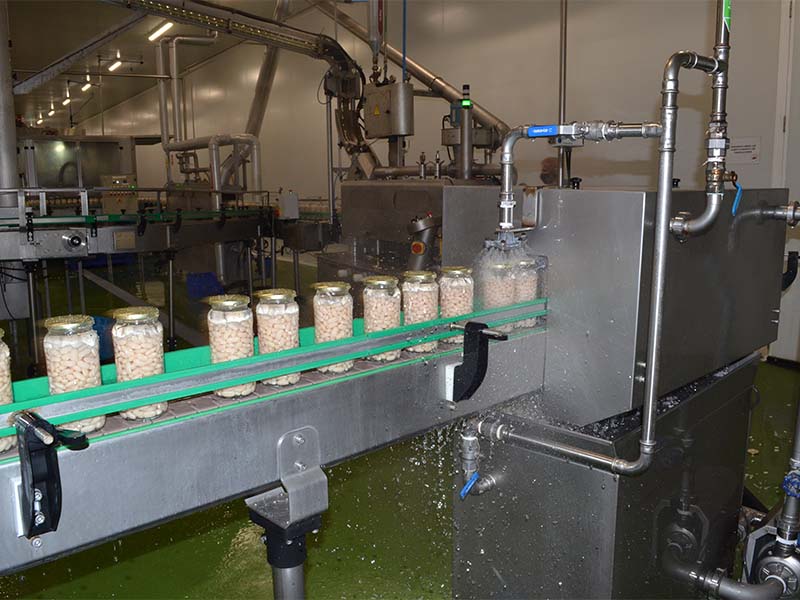 Below is a very brief and schematic example of how to apply the HACCP system in a specific case: a cooked vegetable company such as Autor Foods. With this plan, the company guarantees that its cooked vegetables, both in jars and cans, reach the consumer in a safe, harmless condition and with consistent quality.
| Principle |
Application in a pulses company |
| Hazard analysis |
Raw materials: Biological (bacteria, mould, toxins), physical (stones, plant debris, metals) and chemical (pesticides, water contaminants). Processing (soaking, cooking, packaging, sterilisation): risk of Clostridium botulinum survival if heat treatment is insufficient. Packaging (glass and cans): physical risks (broken glass, welding defects) and chemical risks (migration of materials). Storage/distribution: corrosion of cans, breakage of jars, loss of sterility due to mishandling. |
|
Critical Control Points |
Receipt of raw materials → quality control and rejection of contaminated batches. Cooking and blanching → reaching the appropriate temperature to reduce microbial load. Packaging and sterilisation → destruction of C. botulinum through control of time, temperature and pressure. Hermetic sealing of containers → verification of sealing (visual inspection, vacuum, leak detection). |
|
Critical limits |
Cooking: minimum X °C for X minutes (depending on the vegetable). Sterilisation: ≥ X °C for validated time. Sealing: minimum specified vacuum, no leaks. Process water: compliance with drinking water regulations. |
|
Monitoring system |
Use of calibrated thermometers and pressure gauges in autoclaves. Automatic/manual recording of temperatures and pressures. Daily checks of airtight seals. Periodic microbiological analysis of batches. |
| Corrective measures |
If sterilisation does not reach the required time/temperature: reprocess or withdraw the batch. Seal failures: stop line, correct machine, remove defective containers. Non-compliant water: halt production until quality is restored. |
| Verification |
Regular internal audits.- Microbiological analysis of finished product (absence of pathogens). Validation of autoclaves with biological indicators. |
|
Records |
Raw material receipt records. Records of cooking and sterilisation temperatures/times. Container closure checks. Laboratory results. Corrective actions taken. |